
This course covers the content presented in the Mental & Emotional Health section of the Caregiver Health, Wellness, and Resilience Masterclass. It includes The Stress Thermometer mini-course, The Guilt Meter Tool mini-course, the Mindfulness for Caregivers mini-course and more on the topics of stigma, mindfulness, stress, and guilt. It includes video interviews, activities, and a workbook (found at the bottom of this page).
Mental health is not just the absence of mental illness. It’s about thriving, adapting, and finding fulfillment in life despite challenges.
Good mental health brings a wide range of benefits that contribute to your overall well-being and quality of life. Here are some of the key advantages of maintaining good mental health:
- Emotional Resilience: Good mental health helps you navigate caregiving challenges and setbacks with greater emotional resilience and adaptability.
- Positive Outlook: It fosters a positive mindset, enabling you to approach the care situation with optimism and hope.
- Effective Coping: Good mental health equips you with healthy coping strategies to manage inevitable stress, anxiety, and other emotional challenges that come with being a caregiver.
- Improved Self-Esteem: Good mental health contributes to a stronger sense of self-worth and a positive self-image.
- Optimal Productivity: It enhances your ability to focus, concentrate, and stay productive as a caregiver and in other various areas of your life.
- Better Decision-Making: Good mental health improves your ability to think clearly, make rational decisions, and consider long-term consequences. It also stimulates creative thinking and problem-solving by fostering an open and flexible mindset.
- Reduced Anxiety and Depression: Good mental health lowers the risk of experiencing and exacerbating symptoms of anxiety and depression, which are common among caregivers.
- Physical Health Benefits: Mental health and physical health are interconnected. Good mental health positively impacts your immune system, cardiovascular health, and overall well-being.
- Quality Sleep: Maintaining good mental health can lead to better sleep quality and more restful sleep patterns.
- Respect for Boundaries: Good mental health encourages setting healthy boundaries in relationships and valuing your personal needs.
- Personal Growth: It fosters continuous self-improvement and personal growth, encouraging you to learn, evolve, and adapt.
- Happiness and Fulfillment: Ultimately, good mental health contributes to a happier, more fulfilling, and meaningful life experience.
What you’ll get with this course:
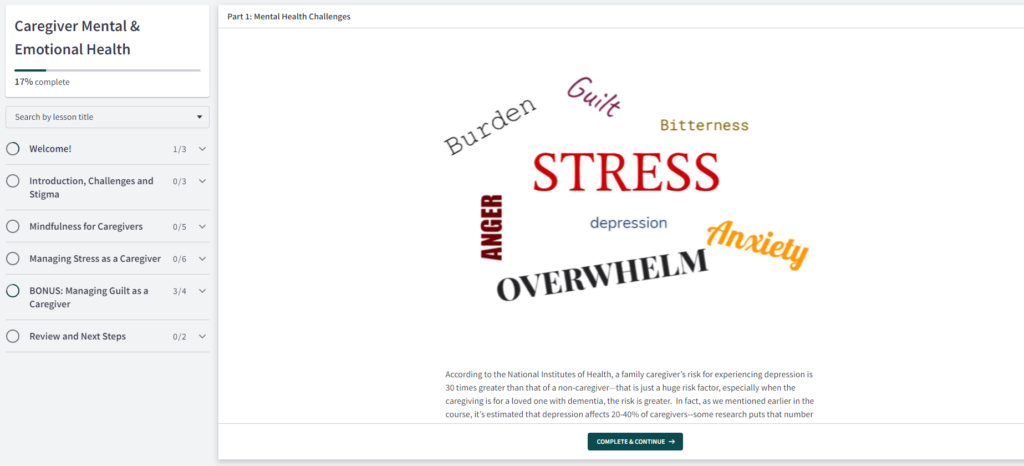
- Full Course with 5 activities (2-3 hours to complete)
- Mindfulness for Caregivers
- Guided Practice – Grounding Activity
- Guided Practice – Nourishing the Caregiver
- The Stress Thermometer
- Observing feelings
- Mind & body connections
- Identifying triggers
- Sorting Your Spheres
- Exploring what is controllable
- The Guilt Meter
- Observing guilt
- Identifying healthy vs. toxic guilt
- Taking Action
- Creating action plans
- Mindfulness for Caregivers
- Downloadable Workbook
- Complete the activities
- Take additional notes
- Access to the Community for Caregivers Facebook Group
Caregiver Mental & Emotional Health Workbook
